

Decking and siding may carry the lion's share of demand, but they are not the only uses for the material or the sale.
When a customer begins with a deck, deck boards are the primary order. But the project may also need siding, exterior trim, a porch ceiling, a privacy wall, or an interior feature wall. These are not separate material conversations. At Westwood Millworks, we offer a great opportunity for a single product-family conversation.
Thermal modification changes how wood responds to moisture. Compared with untreated wood, thermally modified wood takes up less moisture and offers better dimensional stability and decay resistance. The board retains those properties whether it is used on a deck, a wall, an eave, or an interior surface.
Understanding the larger project creates a broader opportunity for dealers. It also gives architects and builders a consistent real-wood option beyond decks and siding.
The opportunity beyond decking and siding
Decking and siding gave thermally modified wood its foothold for good reason. Both are large, visible applications that expose wood to regular changes in moisture and temperature and support the wood's stability story.
A category built around those two applications can overlook other parts of the same job. The customer choosing deck boards may also need trim around a door. The builder pricing siding may be working through a soffit. The architect who wants real wood outside may also want the same tone on a lobby wall or ceiling plane.
Westwood is well positioned for that discussion because it handles thermal modification, milling, profiling, and finishing under one roof in Macon, Georgia.
Three product conversations beyond decking and siding
-
Bringing the material indoors: ThermA Planking.
ThermA Planking gives dealers an interior product for feature walls, bedrooms, kitchens, hospitality spaces, and ceiling planes. Fireplace surrounds may also be considered when the product, clearances, and assembly meet project requirements.
The planks are 1/4 inch thick, 4 feet long, and 5 inches wide, with square edges. Each box covers 10 square feet. From custom builders to serious DIYers, customers can choose from a range of weathered colors. The product page also reports a 4.9-star average customer rating.

2. For large surfaces and more depth: ThermA Fluted
ThermA Fluted trades a flat surface for repeated shadow lines and depth. It works on interior feature walls, in hospitality and retail spaces, in reception areas, and in covered exterior applications when the product and assembly fit the exposure.
Architects and builders looking for texture, light, and rhythm across a large surface can specify a milled wood option. For dealers, ThermA Fluted can be an upsell on a residential project and an entry into commercial interiors.

3. ThermA Trim completes the exterior wood package.
New to our lineup, ThermA Trim may cover less square footage than siding, but it is where the exterior comes together. Corners, windows, doors, fascia, and other transitions finish the larger wood package.
Westwood's new ThermA Trim line gives dealers an answer when a customer asks how to complete the job. It also keeps the exterior wood discussion with the same manufacturer that modifies, mills, finishes, and supports the siding and decking.
We're excited to share this with you – availability coming soon.
One project can carry several Westwood products.
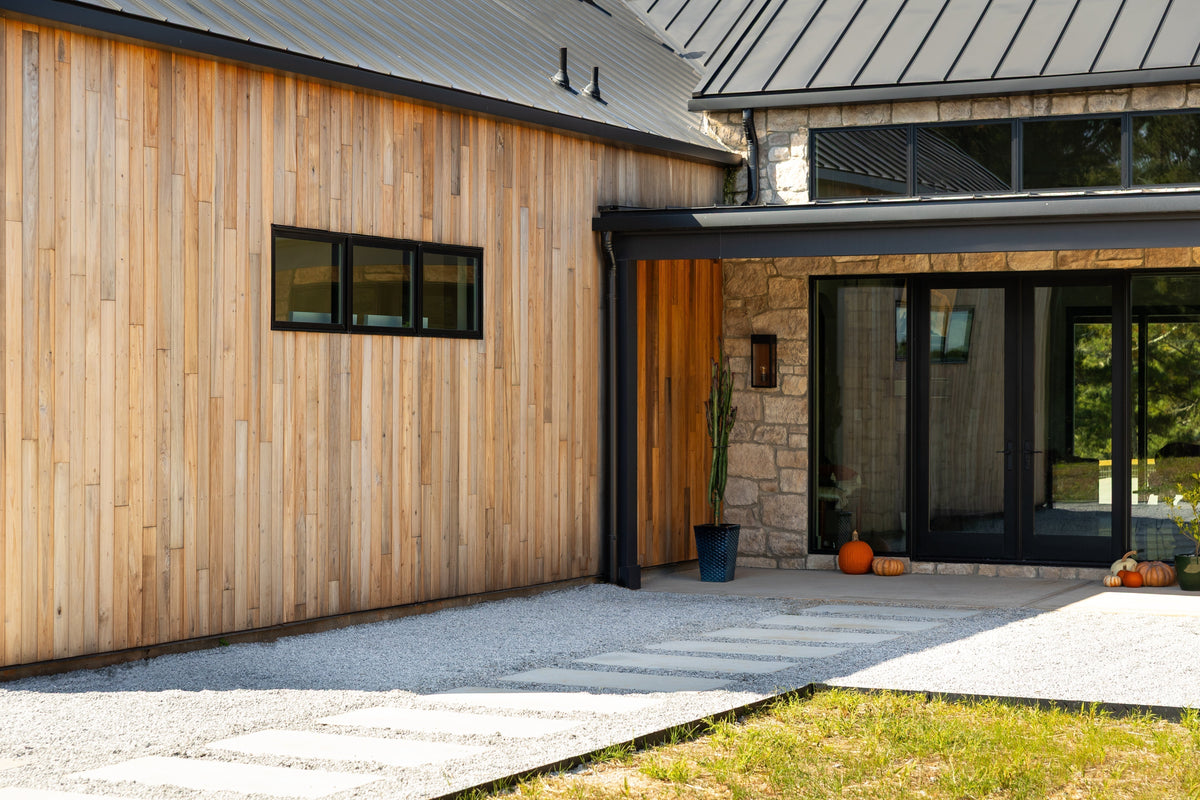
Picture a lake house, restaurant, or mixed-use project. ThermA Decking starts at the terrace. ThermA Siding moves up the wall. ThermA Trim completes the openings and corners. A soffit or porch ceiling carries wood overhead. ThermA Planking or Fluted brings it inside.
The products do not have to match across every surface. The value for dealers is offering several applications from one manufacturer.

What can dealers put in front of the customer?
Sell the application first.
Customers typically don't ask for thermally modified wood. They are more likely to ask for a porch ceiling, slat wall, exterior trim board, or real-wood accent wall. Organizing samples around those projects helps customers find the product that fits the job.
A product display can connect the family: one decking sample, one siding profile, one trim board, one Planking board, and one Fluted sample. Current product guides and installation instructions can answer the technical questions. When a detail needs review, bring Westwood into the conversation early.
The category is larger than its two biggest products.
Decking and siding will continue to carry much of the thermally modified wood market. They also provide a starting point for a longer conversation and a broader sale.
Westwood's product family gives dealers a clear answer when projects move beyond those first products. Different jobs. One material category.

Leave a comment
This site is protected by hCaptcha and the hCaptcha Privacy Policy and Terms of Service apply.