
Most deck failures don’t announce themselves. They build quietly — a fastener that corrodes a little more each winter, a ledger that lets moisture in at the seam, a board that softens from the bottom up while still looking fine on the surface. By the time a homeowner notices something is wrong, the repair is rarely simple.
May is Deck Safety Month — a good prompt to slow down and actually look at what your deck is telling you. At Westwood Millworks, we think deeply about decking materials. Here’s how to read what your deck is showing you, what the warning signs really mean, and how to make smarter decisions about what comes next.
Your Material Determines What You’re Looking For
Not all deck inspections are the same — because not all decking materials fail the same way. Knowing what your deck is made of shapes what you prioritize.
- Pressure-treated lumber will initially resist rot, but over time it will move, causing boards to cup, twist, or develop checks (surface cracking along the grain). PT will undergo moisture cycling, meaning the wood will absorb and release water over time. It’s also a good time to check for corrosion on your fasteners, as some chemical treatments accelerate hardware deterioration.
- Cedar and naturally durable species hold up beautifully for years — until they don’t. End grain is the vulnerability. Check the cut ends of boards and the base of any posts for soft, spongy wood. That’s rot starting from the inside.
- Composite decking won’t rot, but the substructure beneath it will. If your composite surface looks fine but the deck feels soft underfoot, the joists and framing need attention—not the boards themselves.
- Thermally modified wood like ThermA Decking is engineered to repel moisture at a molecular level, which means the typical failure modes — rot, warping, swelling — are largely eliminated. Annual inspection is still worthwhile, but the threshold for concern is considerably higher.
LITTLE KNOWN FACT
Composite decking can cup despite its reputation for low maintenance. Most composite boards contain a wood fiber core, and when moisture penetrates an aging or uncapped surface, that core absorbs water unevenly — the sun-exposed top face expands and dries at a different rate than the underside, causing the board to curl at the edges. Poor gapping during installation makes it worse, as boards with no room to expand laterally have nowhere to go but up. Adequate airflow beneath the deck and proper spacing at install go a long way toward preventing it.
The Four Areas Every Deck Inspection Must Cover
Regardless of material, a proper deck safety inspection touches the same four zones:
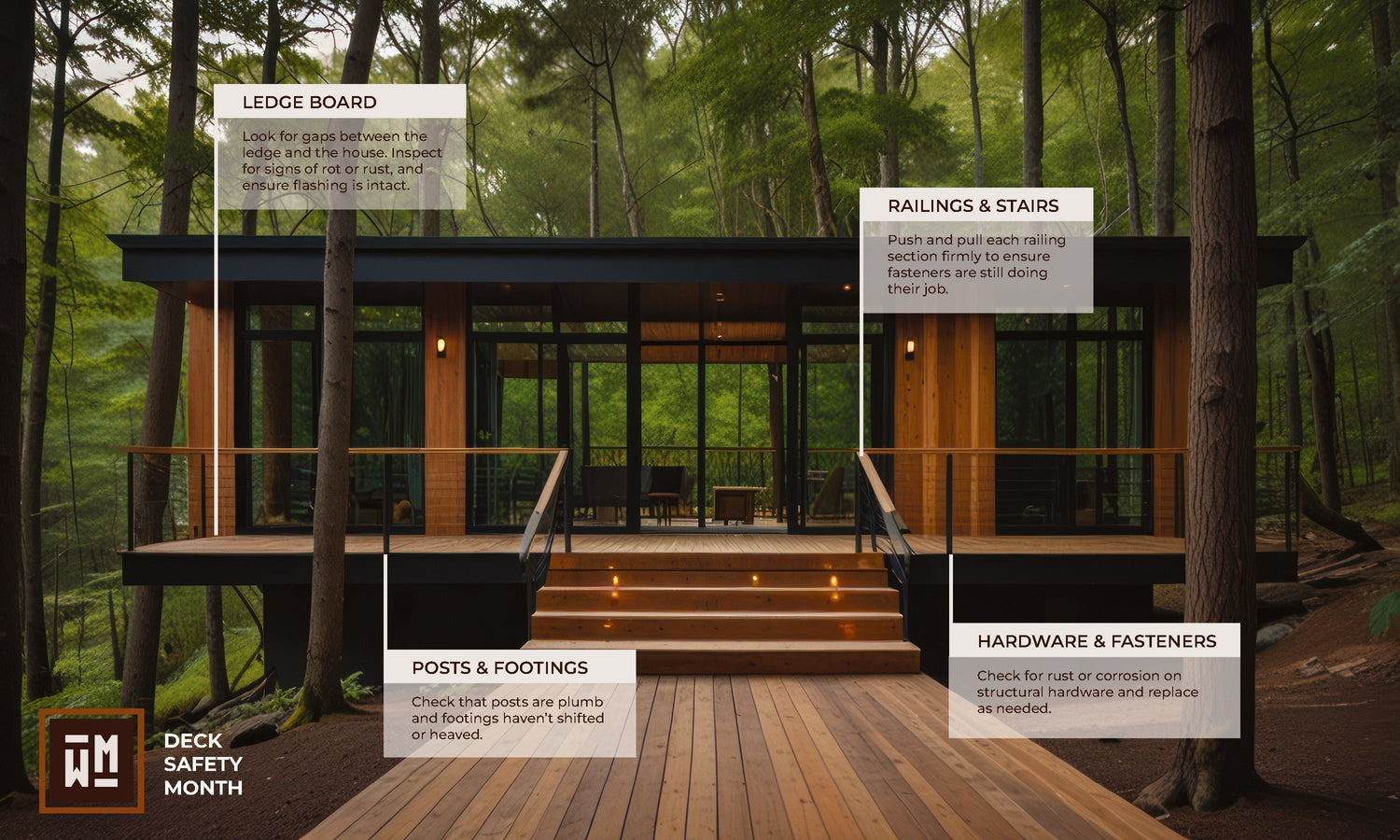
- The ledger board. This is the single most critical structural connection on an attached deck. Water infiltration at the ledger is the leading cause of catastrophic deck failure. Look for any gap between the ledger and the house, signs of rot or rust, and whether the flashing is intact.
- Posts and footings. Check that posts are plumb and that footings haven’t shifted or heaved. Post bases sitting in standing water or direct soil contact are a long-term liability regardless of the material.
- Railings and stairs. Push and pull each railing section firmly — any movement is a fastener problem, not a cosmetic one. Per IRC code, residential guardrails must be at least 36 inches high and have balusters no more than 4 inches apart. Stair handrails must be graspable and anchored at both ends; this is a code requirement, not a recommendation.
- Hardware and fasteners. Joist hangers, post caps, and beam connectors do quiet, critical work. Rust or corrosion on structural hardware isn’t just aesthetic — it’s load capacity being eaten away. Replace compromised hardware with corrosion-resistant connectors rated for exterior use.
Repair or Replace? How to Read the Signs
The most important question a deck inspection can answer isn’t just “what’s wrong” — it’s “is this worth fixing, or is it time to rebuild?”
- Repair makes sense when damage is isolated — a few boards, a railing post, corroded fasteners. If the substructure is sound and the problem is clearly contained, targeted repairs are cost-effective and extend the deck’s life significantly.
- Replace when rot has reached the framing, if ledger damage is extensive, more than a few posts show movement, or you’re making short-term patches of the same issues each season. Making recurring repairs to an aging deck is a signal, not a solution. At some point, the cost of ongoing maintenance exceeds the cost of rebuilding with better materials.
What Your Next Deck Is Made Of Matters More Than You Might Think
If your inspection leads to a rebuild, it’s worth having a conversation about changing materials. Most deck failures are predictable — and most are material-driven. Pressure-treated lumber moves significantly as it dries, leading to the warping and fastener issues that populate most repair lists. Traditional cedar, beautiful as it is, demands consistent sealing and maintenance to reach its full lifespan.
ThermA Decking by Westwood Millworks approaches durability in a different way. Thermally modified at 400°F using only heat and steam — no chemicals — the wood’s cellular structure is permanently altered to repel moisture, resist rot and insects, and stay dimensionally stable through years of seasonal change. It’s backed by a 20-Year Durability Guarantee and arrives factory-sealed on all four sides, ready to install.
The best time to make a better material decision is before the next deck goes in. Deck Safety Month is a reasonable moment to start that conversation.
Ready to talk decking? Contact the team at Westwood Millworks to learn more about ThermA Decking, request samples, or get guidance on your next project. We’re happy to help you build something that lasts.

Leave a comment
This site is protected by hCaptcha and the hCaptcha Privacy Policy and Terms of Service apply.