
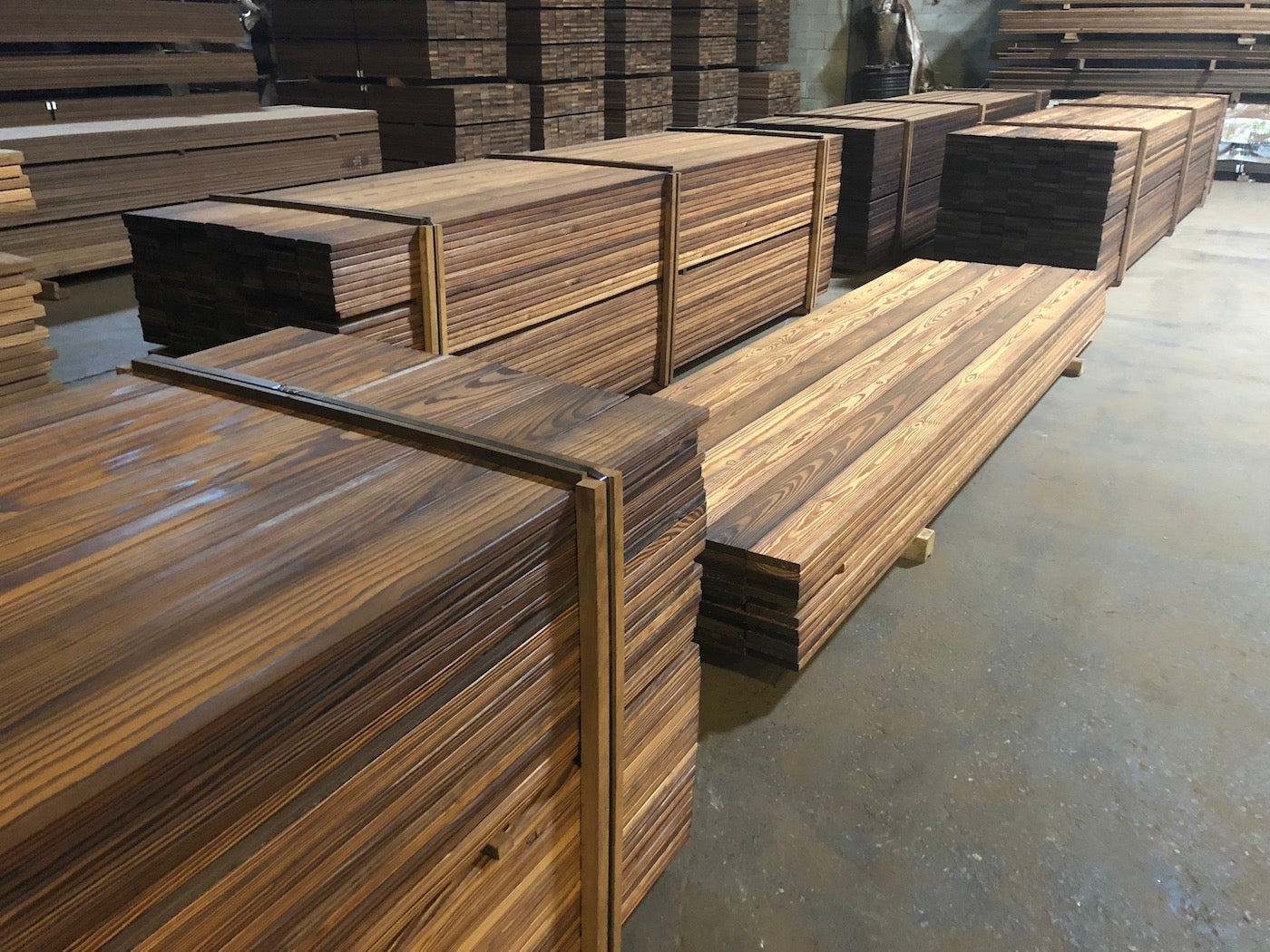
Thermally modified wood is drawing increasing attention in North America. This growth benefits everyone building with wood—fueling more education, specification, and projects ideally suited to thermal modification.
As interest grows, we notice that discussions often focus on equipment, particularly kilns, as the central element of thermal modification. Buying the right kiln and running a schedule may seem like a complete solution, but that view is incomplete.
The kiln, a chamber or oven used to heat wood, is a critical element in manufacturing thermally modified wood products, but it is only one part of the process. The discipline is everything built around this tool.
The Kiln Is a Tool, Not the Craft
Every serious producer agrees: the kiln is just one variable in a complex process. What you put in, how you prepare it, and post-kiln manufacturing steps all determine final material performance on the job site.
“You can buy a similar kiln to the ones we built, but you can’t buy twenty years of sourcing, preparation, and manufacturing expertise.” Peyton Turner
That’s not acting boastful. It’s an operational reality. Variables upstream and downstream of the kiln that most people outside the industry never think about are species and specification selection, pre-modification drying, and post-modification milling to profile. Get any one of them wrong, and the kiln won’t save you.
Species Selection: The First Decision That Matters
Every species reacts differently to heat and steam, and even within the same species, responses vary depending on grading and dimensional specifications. That's not a theoretical point - it shows up in the finished product. The process we run for Poplar isn't the same process we run for Southern Yellow Pine. Ash has its own set of considerations. So does Western Hemlock. Among those, 8/4-thickness raw material is treated differently than 4/4. There's no single process you can apply across all of them and expect a consistent, durable result.
Before a run starts, we must know exactly how a species will react—Poplar and Southern Yellow Pine respond differently to heat and steam; so does Ash. Using the wrong process for a species can result in defects such as surface checks and color inconsistency. These are not necessarily kiln problems, but issues resulting from decisions made before the kiln modification stage.
We run four North American species — Poplar, Ash, Southern Yellow Pine, and Western Hemlock — all domestically sourced. Each one has a process protocol that took years to develop. You don't figure that out in your first season. Part 2 of this series goes into detail on each species.
Drying: An Important Step
Moisture going in matters more than most people realize. If a board isn't properly dried before it's modified—meaning moisture removed so it reaches a stable level—you're not fixing that in the kiln; you're likely causing other problems. We've pulled boards out that looked fine going in and found exactly that—warping (the board twisting, cupping, or bending), checking (cracks), color variation—and it doesn't make sense until you trace back to the wood’s properties before modification started.
This step is also the hardest to assess from the outside. While kilns can be seen and counted, consistent management of what goes into them is only built through experience and rigorous controls developed over time.
Milling After Modification: Where It Shows in the Board
The board that comes out of the kiln is not the board that ships to a job site. Post-modification milling—meaning profiling the board to its final shape and dimensions, ensuring tolerances (the allowed variation from specified measurements), and finished product quality control—is where manufacturing discipline either holds or breaks down.
Thermal modification alters the cellular structure of the wood. It becomes more dimensionally stable, but it also behaves differently under cutting tools than green or kiln-dried lumber. Feed rates, cutter geometry and material, and profile tolerances — they all need to account for what the wood has been through. Operators who understand the material from the kiln to the finished board hold tighter specs and produce a more stable product. Those who don’t tend to learn on the job site.
What Nearly Two Decades of Operational Ownership Actually Builds
Westwood Millworks built its first proprietary kiln in 2007, making us the first industrial-scale domestic producer of thermally modified wood in the United States. Nearly two decades later, we’re still designing, building, and operating that kiln technology entirely in-house, in a controlled indoor facility in Macon, Georgia.
The timeline matters, but not as a credential to wave like a flag. It matters because everything described above — species & spec protocols, drying schedules, milling tolerances, process & quality control — accumulates over time. The process knowledge we have today is not the same as it was in 2010 or 2015. Every species and spec tested, every production run, and every question that came back from a job site made the process better.
Pull Quote from Peyton: “We built the first kiln from scratch because no one had ever done it here. And we’ve been refining it ever since.”
Owning every step — kiln design, species sourcing, modification, milling, and even pre-finishing — all under one roof in the U.S. is what being a true domestic producer means. Not just where the product ships from, but where decisions get made, and who’s accountable for them.
The Category Is Growing. The Discipline Gap Is Real.
More producers are now entering the thermally modified wood market, which is good for the category. Increased participation leads to more education, specification pathways, and adoption for projects where this material excels.
The conversation needs to recognize that thermal modification is a manufacturing discipline, not just about one piece of equipment. The kiln is imperative, but expertise and process control determine the quality of the final board.
This commitment to discipline and excellence is what sets Westwood apart and underpins everything in this series.

Peyton Turner is President of Westwood Millworks, a Macon, Georgia manufacturer of thermally modified wood. Since 2007, the company has run proprietary kiln technology it designed and built in-house, turning North American hardwoods into its ThermA Decking™ and ThermA Siding™ lines. Inspired by Nature. Perfected in Georgia.

Leave a comment
This site is protected by hCaptcha and the hCaptcha Privacy Policy and Terms of Service apply.